Smokey the Bear is Burning the West
By Jennifer Hill
Smokey Bear has proven to be one of the most successful US Government propaganda programs in our history. The smiling, uniform clad bear who tells us that fire is always dangerous has contributed to a culture of complete fire suppression, directly leading to degraded range conditions and terribly high fire danger across most of the west. As a people we have bought the bear’s story (quite literally- there are Smokey Bear children’s books) along with his posters, t-shirts, commercials and even catchy tunes without realizing that Smokey’s message has, in fact, created a critical situation.
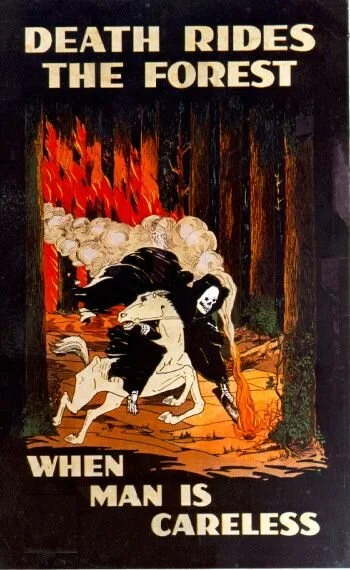
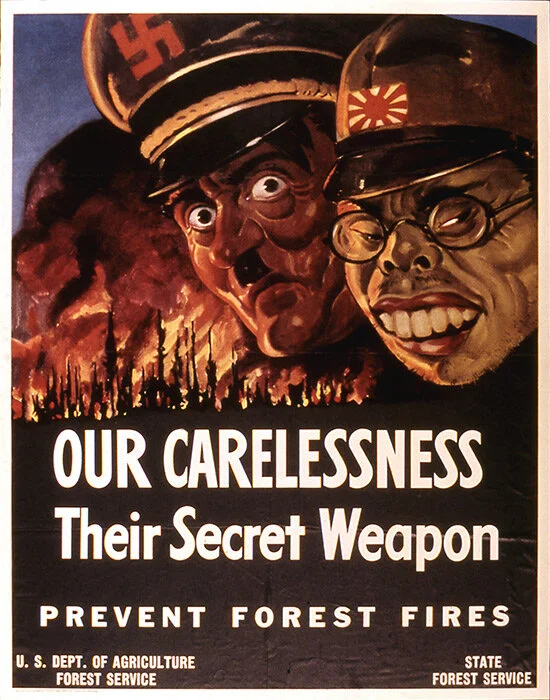
Smokey Bear (his official name actually doesn’t include the middle name ‘the’) was created in the fall of 1944 as a joint venture with the U.S. Forest Service and Ad Council, making it the longest running public service ad campaign in the nation. Following the 1941 Japanese attack on Pearl Harbor, the War Advertising Council worked with the Forest Service to develop a forest fire prevention program that coined frightful slogans like “Forest Fires Aid the Enemy” and “Our Carelessness, Their Secret Weapon” as a way of convincing Americans that preventing forest fires could aid the war effort. A year later Walt Disney lent the use of the cartoon deer Bambi to the campaign. The success of the cute orphaned deer on the fire prevention posters provided proof of concept that cute animal plus scary fire equals a public willing to obey.
Clearly Smokey and his anti-fire campaign have been a success, if fewer acres burned means success. According to the National Interagency Fire Network, when Smokey debuted in 1944 just over 16.5 million acres across the U.S. burned. (The agency acknowledges that reporting prior to 1983 was not regularized, and therefore unverified.) For the next decade the number of acres burned stayed relatively flat. By the mid 1950’s there was a sharp decline in land allowed to burn, averaging around 5 million acres burned each year for the next 70 years, with a few exceptional years, including the jump from 4.7 million acres burned in 2019 to 10.1 million acres in 2020. During this time the amount of taxpayer money dumped into fighting wildland fires has grown at an incredible rate. The 2020 Wildland Fire Management Budget was $952 million. The feds have allocated $1 billion (with a ‘b’) for this year. The government has decided that every flame must be doused, no matter the expense. But is heavy fire suppression and a flood of money literally thrown into the flames really a good thing, and are we setting ourselves up for future disaster?
Ranchers across the west have seen the negative impacts from this anti-fire stance. We live on lands where 100 years ago fire (both natural ignition and manmade) was regularly used to regenerate the ecological system. Without it the hillsides have become nothing more than a pinyon and juniper woodland, choking out native grasses. Forested areas are full of downed timber and beetle kill. Springs that once flourished are no more as the overgrown trees take up more of the limited water supply. The land is begging for a fire, and as the data from 2020 shows, when it decides to burn, it burns big and quickly becomes unmanageable.
The federal government occasionally pretends to acknowledge this problem, using flowery words to talk about the importance of fire in an ecological system, yet they continue to stomp out every flame, disallow controlled burns and throw those who dare to disagree in prison. The Hammond family in Oregon is an excellent example of the consequences ranchers may face for trying to save the range. Convicted in 2012 of arson for burning invasive weed species more than ten years prior, the father and son duo spent decades in the court system, years in prison, were accused of being domestic terrorists and eventually lost most of their ranch before receiving a Presidential pardon in 2018. The message to western ranchers who have spent generations using prescribed fire as a rangeland tool was clear, you burn it and we burn you.
So what is it that the federal government is so afraid of? That a prescribed fire might grow too big and threaten communities? Well that’s happening every summer anyway. Or is it about the money, as wildland firefighting quickly becomes a billion dollar industry? Is it pressure from a public that has been propagandized to believe that every fire is dangerous, spend all their time watching the news in fear and are truly junkies for the drama these fires bring? In the meantime our country will keep stamping out every spark because Smokey told us to. Then when we get hot, dry years we’ll scramble to prevent the entire western US from going up like the tinderbox it is. Perhaps it's time for Smokey to realize that the best way to prevent wild fire is with fire.