Ballot Box Tyranny is Killing Rural America
By Jennifer Hill
We live in a celebrated Democratic Republic. As children we are taught in our publicly funded schools that democracy is sacred, and voting is a moral obligation. Every four years we are told that the biggest problems our nation faces is that not enough people get out and vote. But as our population grows in size so does the urban/rural divide, changing the way our democracy functions. The rift has created a situation where a majority of the people are not only allowed, but encouraged, to make decisions on behalf of others. Decisions on subjects about which they know very little and with consequences they will never have to live with.
Last fall the state of Colorado fell prey to ballot box biology when, by a slim margin of 50.3 percent to 49.7 percent, the voters in the urban front range of the state approved a measure to reintroduce wolves in the rural northwestern part of the state. The plan was opposed by numerous wildlife foundations and support groups, agricultural associations and even all of the impacted counties. The counties in green on the map are those that approved the wolf reintroduction.
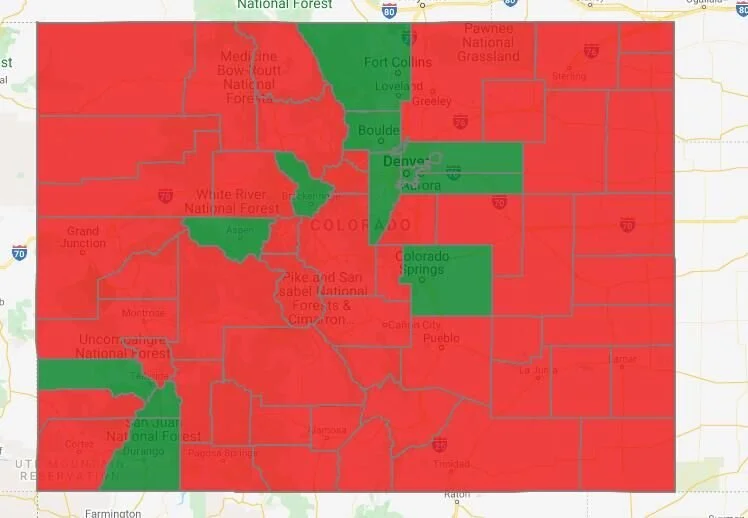
You’ll notice that they are nowhere near the northwest corner of the state where the once eradicated predator is to be released, nor are they areas of the state with any vested interest in rural or agricultural communities. The city dwellers of the state simply decided it would be nice to have some wolves, just nowhere near them. And by simple majority they won.
Farther to the west, Oregon’s Initiative Petition 13 is the stuff of rancher nightmares. The proposal, which could potentially be approved based on the uninformed opinions of the unimpacted, would classify animal slaughter as aggravated abuse and redefine artificial insemination and castration as sexual assault, effectively destroying animal agriculture within the state. Additionally the bill would outlaw hunting and fishing as forms of animal slaughter. In order to make next year’s ballot, the petition will need a mere 112,000 signatures by next summer. Oregon is currently home to roughly 12,000 beef producers who raise about 1.3 million head of cattle. In a state of 4.2 million, their voice may not be the loudest, but it is their livelihoods that will be ruined.
Earlier this summer the Colorado Supreme Court overturned a similar measure in the state before it reached voters, citing multiple subjects within the proposed bill. While the relief of agriculturalists was palpable, it’s worth noting that the bill was overturned not because shoving unnecessary, radical policies down the throats of millions would be unethical, but because of a technicality.
Was this the goal of the democracy that our founders envisioned? That citizens would be able to enact policies that would solely impact others, despite the vehement opposition by those who would truly bear the consequences? Does the fact that something was democratically chosen make it morally acceptable, or just more palatable for the uninformed? As the differences in lifestyle, moral background and belief systems continue to grow and change between rural Americans and the urban dwellers the pressures urbanites are able to democratically place on the rest of us will expand as well, making one wonder, will this system work forever?